Ghosts in the Valley: An Evening of Legends, Lore, and Local History at the Seymour Historical Society
At a full-house fall program, guests followed presenter Michael through 150 years of eerie headlines, neighborhood rumors, and document-backed mysteries stretching from Ansonia and Seymour to Kinneytown and beyond.
SEYMOURHISTORY
10/29/20254 min read
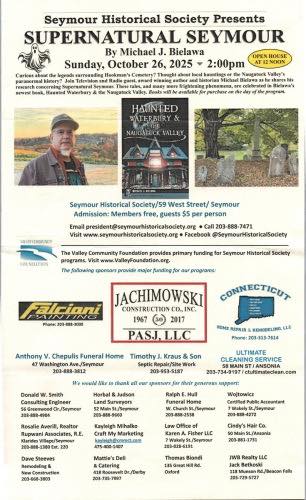
You know those nights when the whole room feels like neighbors? That was the vibe at the Seymour Historical Society. We squeezed in, the lights dimmed, and our host, Mary, a Seymour Historical Society Board Member, reminded us that this was the last program of the season, and thanked everyone for attending.
Then came our presenter: Michael Bielawa, the guy with the bottomless file boxes and the “I swear I can back this up” grin. He promised legends and scary stories, but with receipts: dates, clippings, and those little historical breadcrumbs most of us miss. “I don’t make this stuff up,” he said. “I chase the facts and watch how stories move through time.”
If you’ve ever handed a relative a piece of family history and watched their eyes go soft, you get him. He once proved a family tale about a 500-foot home run in Mystic using old newspaper clippings. They wrote back: “Every Thanksgiving, we read your letter to our family.” He chuckled. “Tonight my goal is simpler—to scare the bejesus out of you.”
The Ansonia Knockings (1886)
First stop: Ansonia, February 1886. Imagine an entire neighborhood kept awake by knockings night after night. People gathered on porches. No one slept. Michael read between the lines. There was Irish superstition in the newspaper write-up and a hint of a recent death. He followed the trail through tiny notices and census pages until a name surfaced: Jenny Ryan, 21, who died February 3, 1886, two days before the knockings started.
Where is she buried—Pine Grove? Bear Plains? St. Mary’s? Floods changed streets, names shifted, and yet all the clues sit within a short walk of downtown. If you go looking and find the Ryan plot, maybe… let him know gently.
Kinneytown’s Pressure in the Dark
Then up into the hills of the area known as Kinneytown, where farms and cider mills once dotted the roads. Late-1800s locals whispered about something in the woods. One man, Peter Hinckley, said an unseen force pressed on his shoulder and chest, pinning him on the road. Others quietly admitted the same. Michael reminded us this isn’t just a Valley thing. “Roadside entities” are part of folklore all over the world.
Another witness, Minot Smith, reported a looming figure “imprinted on the midnight blackness.” His account ran in the New York Sun on November 29, 1896. Smith went on to serve in Orange town government, hardly a crackpot, just someone who saw something he couldn’t shake.
Midnight Music on the Flats & a Monster by the Church (1890s–1901)
Down from the hills to the Seymour flats, factory workers pedaled home around midnight and heard music in the trees, a figure in a long white robe playing a hornpipe. Newspapers shrugged it off as a prank. The stories kept coming.
By November 1901, it wasn’t so whimsical. Men crossing near the river by the Congregational Church met what they called a “monstrously large” figure with green eyes and a whitish-green robe, bursting from the woods, right around today’s overpass. Michael used that moment to talk about old boundaries: moving water and sacred places as lines that ghosts and monsters supposedly can’t cross. In other words, the Naugatuck River and a church might be more than scenery on a dark walk home.
A Broken Stone on Great Hill (and a Typo That Moved a Grave)
In Great Hill Cemetery (Holbrook & Cemetery Roads), a broken marker tells two stories. Ephraim Wooster died in the New York steamboat New Haven boiler explosion on September 11, 1830. His son Joseph, the stone says, died at “New Liberia” and was buried on the “Isle of Belize” in 1832.
Except... Michael’s research suggests the inscription led everyone astray. It likely meant Lovelace—a pilot outpost at the mouth of the Mississippi... not Belize. Hurricanes flattened the place by the 1860s, and people later reported tombs slipping into the Gulf. So the Great Hill stone isn’t a grave at all—it’s a cenotaph, a memorial for loved ones buried elsewhere. A father lost to New York waters, a son to the Gulf. One family, two seas.
Hookman on Cemetery Road (Yes, Our Version)
If you grew up here, you know Hookman. A young couple on Cemetery Road, a scraping on the roof, and when they finally pull into the driveway, there’s a hook at the car door. Some say it was a graveyard caretaker with a guilty conscience. Others say a man was chased and lynched. Another version: an escapee from an asylum. Michael zoomed out to national news. Lovers’ lanes, the 1946 Texarkana murders, pop-culture warnings, and then back to us with a grin: “There’s a Hookman in almost every state. The one in Seymour is the real one.”
Sleep tight—and maybe don’t park under the trees.
Ghosts, Skeptics, and the Places We Love
The Q&A turned into a local map of “you didn’t hear it from me” stories:
Franklin Street (Seymour), by St. Michael’s/old Franklin School: shadow figures, phantom kids’ laughter in the halls.
Near the Whitmore Tavern and the trestle: a tight cluster of houses and a sprinting apparition.
Sterling Opera House (Derby): beloved tales (some say the ghost is “Andy”), though researchers spar over hard proof.
Ansonia Opera House: a prominent owner insists it’s not haunted—full stop.
Beacon Falls Mill (across from the river): long-standing rumors, now apartments; one resident’s laundry-room chill keeps the story alive.
Buckingham Place: an unseen thwack on the head—and a house ghost reportedly known as “Fred.”
Great Hill Cemetery: Scouts have fixed stones there; plenty of us still won’t walk it alone at dusk.
Michael reminded us that cemeteries weren’t always spooky. For generations, they were green, communal spaces. Some places—New Orleans, for one—still picnic among relatives. Different tradition, same love.
When the talk wrapped, Michael signed books in the parlor, and the room melted into the kind of small-town conversation that mixes raffles, crochet, and “oh, say hi to so-and-so for me.”
“These stories creep in like waves,” Michael said. In the Valley, from Ansonia to Seymour, they never quite leave. Honestly? We kind of like it that way.
If You Go: Holiday Happenings at the Seymour Historical Society
November: Decorating and prep
Santa Visit: First Saturday (check the Society’s calendar for exact hours)
Holiday Vendor Day: The very next day. The house will be fully decorated, with local makers in every room
Community
Connecting residents of The Valley - The Lower Naugatuck River Valley.
Engagement
Kayleigh@cmmct.com
Copyright © 2026
Branding, digital, and marketing by Kayleigh.
All Rights Reserved.
This site is run by community member Kayleigh Mihalko, Executive Director, Electronic Valley
About
About Electronic Valley
About Kayleigh